Baiting
The pepsin solution was reheated to 37 C to continue to bait the large pieces of hide. The solution was stirred using the magnetic hot plate stirrer.
Vegetable Tanning
The test strips being tanned in different concentrations of oak bark solution were left to continue tanning.
Showing posts with label Vegetable Tanning. Show all posts
Showing posts with label Vegetable Tanning. Show all posts
Saturday, July 23, 2011

July 20, 2011
Baiting
The pepsin solution with the test strips was heated to 37 C and stirred with a magnetic stirrer.
Alum Tanning
The piece of hide in the alum tanning solution was removed from the solution, rinsed, and left to dry. It is unclear whether the alum tanning process worked. The hide appears to be more opaque and slightly more dimensionally stable, however it does not appear to have leather-like qualities.
Vegetable Tanning
The piece of hide that was in the 100% oak bark tannin solution was removed from the solution, rinsed and left to dry. The pieces of hide in other concentrations were left in solution to continue tanning.
The pepsin solution with the test strips was heated to 37 C and stirred with a magnetic stirrer.
Alum Tanning
The piece of hide in the alum tanning solution was removed from the solution, rinsed, and left to dry. It is unclear whether the alum tanning process worked. The hide appears to be more opaque and slightly more dimensionally stable, however it does not appear to have leather-like qualities.
Vegetable Tanning
The piece of hide that was in the 100% oak bark tannin solution was removed from the solution, rinsed and left to dry. The pieces of hide in other concentrations were left in solution to continue tanning.
July 19, 2011
Baiting
 The large pieces of hide were removed from the distilled water and placed in a baiting solution of 3000 mL of distilled water, 30 g of pepsin, and 30 mL of acetic acid. This solution was heated to 37 C.
Alum Tanning
The test strip was left in the alum tanning solution.
Vegetable Tanning- Oak Bark
The pieces of hide being vegetable tanned were left in solution to continue tanning.

Alum Tanning
The test strip was left in the alum tanning solution.
Vegetable Tanning- Oak Bark
The pieces of hide being vegetable tanned were left in solution to continue tanning.
July 18, 2011
Dehairing
The hair was removed from the large pieces of hide. These pieces were put in distilled water to remove NaOH from their surface.
Alum Tanning
The test strip in the alum tanning solution was left in solution to continue tanning.
Vegetable Tanning- Oak bark
The test strips in different concentrations of oak bark solution were left to continue tanning.
The hair was removed from the large pieces of hide. These pieces were put in distilled water to remove NaOH from their surface.
Alum Tanning
The test strip in the alum tanning solution was left in solution to continue tanning.
Vegetable Tanning- Oak bark
The test strips in different concentrations of oak bark solution were left to continue tanning.
Saturday, July 16, 2011
July 15, 2011
Alum Tanning
The half of the third test strip was left in the alum tanning solution
Vegetable Tanning
Oak
Oak bark tannin solutions were remade to provide more tannic acid for each test strip.
10%- 20 mL of oak bark solution was mixed with 180 mL of distilled water.
15%- 30 mL of oak bark solution was mixed with 170 mL of distilled water.
20%- 40 mL of oak bark solution was mixed with 160 mL of distilled water.
25%- 50 mL of oak bark solution was mixed with 150 mL of distilled water.
50%- 100 mL of oak bark solution was mixed with 100 mL of distilled water.
100%- 200 mL of oak bark solution was mixed with 0 mL of distilled water.
The test strips were returned to their corresponding tannin solution.
Liming
The large test strips were moved from the distilled water to a solution of 3000 mL of distilled water and 30 g of NaOH
The half of the third test strip was left in the alum tanning solution
Vegetable Tanning
Oak
Oak bark tannin solutions were remade to provide more tannic acid for each test strip.
10%- 20 mL of oak bark solution was mixed with 180 mL of distilled water.
15%- 30 mL of oak bark solution was mixed with 170 mL of distilled water.
20%- 40 mL of oak bark solution was mixed with 160 mL of distilled water.
25%- 50 mL of oak bark solution was mixed with 150 mL of distilled water.
50%- 100 mL of oak bark solution was mixed with 100 mL of distilled water.
100%- 200 mL of oak bark solution was mixed with 0 mL of distilled water.
The test strips were returned to their corresponding tannin solution.
Liming
The large test strips were moved from the distilled water to a solution of 3000 mL of distilled water and 30 g of NaOH
July 14, 2011
Soaking
 Three large pieces of hide were cut for test strips and soaked in distilled water. They will be used for tanning with sumac leaves
Alum Tanning
No Change
Vegetable Tanning
No Change

Alum Tanning
No Change
Vegetable Tanning
No Change
July 13, 2011
Vegetable Tanning
Sumac:
Today we met with Dr. Frett of UD's school of Agriculture and Natural Resources to discuss natural dyes he is growing. We got to see Japanese Indigo (Polygonum tintorium) and Goldenrod (Solidago). He also gave us two types of sumac, Fragrant Sumac (Rhus aromatica) and Staghorn Sumac (Rhus typhina), that can be used for vegetable tanning. I removed the leaves from some of the sumac and soaked each sumac species' leaves separately in distilled water.

 Rhus typhina:

Oak
The various concentrations of oak bark tannin were left to continue the tanning process.
Alum Tanning
The piece of hide in the alum tanning solution was left to continue tanning.
Sumac:
Today we met with Dr. Frett of UD's school of Agriculture and Natural Resources to discuss natural dyes he is growing. We got to see Japanese Indigo (Polygonum tintorium) and Goldenrod (Solidago). He also gave us two types of sumac, Fragrant Sumac (Rhus aromatica) and Staghorn Sumac (Rhus typhina), that can be used for vegetable tanning. I removed the leaves from some of the sumac and soaked each sumac species' leaves separately in distilled water.
Rhus aromatica:


Oak
The various concentrations of oak bark tannin were left to continue the tanning process.
Alum Tanning
The piece of hide in the alum tanning solution was left to continue tanning.
July 12, 2011
Vegetable Tanning
To test the concentration at which goat hide will be best tanned with oak bark, I used the oak bark solution created yesterday. I prepared solutions ranging in concentration from 10%-100% oak bark solution as follows:
 10%- 20 mL of oak bark solution and 180 mL of distilled water.
15%- 30 mL of oak bark solution and 170 mL of distilled water.
20%- 40 mL of oak bark solution and 160 mL of distilled water.
25%- 50 mL of oak bark solution and 150 mL of distilled water.
50%- 100 mL of oak bark solution and 100 mL of distilled water.
100%- 200 mL of oak bark solution and 0 mL of distilled water.
To each of these solutions a piece of the large test strips were added.
Alum Tanning
The half of the third test strip in the alum tanning solution was left in solution to continue tanning.
To test the concentration at which goat hide will be best tanned with oak bark, I used the oak bark solution created yesterday. I prepared solutions ranging in concentration from 10%-100% oak bark solution as follows:

15%- 30 mL of oak bark solution and 170 mL of distilled water.
20%- 40 mL of oak bark solution and 160 mL of distilled water.
25%- 50 mL of oak bark solution and 150 mL of distilled water.
50%- 100 mL of oak bark solution and 100 mL of distilled water.
100%- 200 mL of oak bark solution and 0 mL of distilled water.
To each of these solutions a piece of the large test strips were added.
Alum Tanning
The half of the third test strip in the alum tanning solution was left in solution to continue tanning.
Monday, July 11, 2011
July 5, 2011
Alum Tanning
 56 g of alum was dissolved in 950 mL of distilled water. The resulting solution had a pH of 4. In a separate beaker, 28 g of sodium chloride and 14g of sodium carbonate were dissolved in 340 mL of distilled water. The pH of this solution was 6. Both solutions were clear. The second solution was added to the first and both were stirred together. The solution began to foam and turned milky white.
 200 mL of this solution was poured into a smaller beaker. Half of the third test strip was added to this solution to be alum solution tanned.
 150 mL of the alum tanning solution was added to a beaker and unbleached wheat flour was added until the solution became a paste. This paste was applied to the other half of test strip 3.

Vegetable Tanning
 The second test strip was removed from the vegetable tannin solution and soaked in distilled water to remove excess tannins from the hide.

Soaking

Two large pieces of goat hide were placed in distilled water to soak.


Vegetable Tanning


Soaking

Two large pieces of goat hide were placed in distilled water to soak.
June 22, 2011
Baiting
The third test strip was again baited at 37 C. After 3 hours of baiting the test strip was removed from the pepsin solution. The hide was now extremely thin, delicate, and translucent. This test strip was then cut in two pieces. One half will be alum paste tanned and the other half will be alum solution tanned.

Pickling
Both halves of the third test strip were introduced to a solution of distilled water and acetic acid. This solution had a pH of 4. This process lowers the pH of the hide in preparation for the acidic tanning process.
Vegetable Tanning.

Although we had originally intended to gradually increase the concentration of the tanning solution to which the second test strip was exposed; the speed at which the test strip absorbed tannins from the solution was more rapid than we had expected. Therefore, we decided to keep the concentration of the tanning solution the same throughout the entire tanning process. I created a new tanning solution of the same concentration by combining 300 mL of distilled water with 100 mL of quercitannic acid solution extracted from oak bark. The second test strip was added to the new vegetable tanning solution and left to sit.
The third test strip was again baited at 37 C. After 3 hours of baiting the test strip was removed from the pepsin solution. The hide was now extremely thin, delicate, and translucent. This test strip was then cut in two pieces. One half will be alum paste tanned and the other half will be alum solution tanned.

Pickling
Both halves of the third test strip were introduced to a solution of distilled water and acetic acid. This solution had a pH of 4. This process lowers the pH of the hide in preparation for the acidic tanning process.
Vegetable Tanning.

Although we had originally intended to gradually increase the concentration of the tanning solution to which the second test strip was exposed; the speed at which the test strip absorbed tannins from the solution was more rapid than we had expected. Therefore, we decided to keep the concentration of the tanning solution the same throughout the entire tanning process. I created a new tanning solution of the same concentration by combining 300 mL of distilled water with 100 mL of quercitannic acid solution extracted from oak bark. The second test strip was added to the new vegetable tanning solution and left to sit.
June 21, 2011
Vegetable Tanning
The second test strip was left in the oak bark solution to continue the vegetable tanning process.
Baiting
 The third test strip was baited in the same pepsin solution used on June 20th. The solution was heated to 37C and stirred a magnetic stirrer on a hot plate. The third test strip was baited for approximately 4 hours.
The second test strip was left in the oak bark solution to continue the vegetable tanning process.
Baiting

Tuesday, June 21, 2011
June 20, 2011
Alum Tanning
 The alum tanning process did not successfully tan the first test strip. The test strip remained cream colored and rubbery. It was unclear whether the alum tanning process did not work or if the test strip was not properly bated. The third test strip will be used to determine which process did not work.
Vegetable Tanning

 The second test strip was left in the vegetable tanning solution. This piece has become deeper in color.
Dehairing
 Hair was removed from the 3rd test strip.
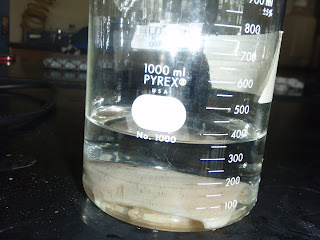 The third test strip was soaked in distilled water to remove the sodium hydroxide.
Baiting
6 g of pepsin were added to 600 mL of distilled water and 18 mL of acetic acid. This solution was heated to 37°C. The third test strip was placed in this solution and the hot plate's magnetic stirrer was used to stirr the solution.

Vegetable Tanning


Dehairing

Soaking

Baiting
6 g of pepsin were added to 600 mL of distilled water and 18 mL of acetic acid. This solution was heated to 37°C. The third test strip was placed in this solution and the hot plate's magnetic stirrer was used to stirr the solution.
June 17, 2011
Alum Tanning
Alum tanning paste was removed from the first test strip and the final layer of tanning paste was applied. This layer will be left on for 3 days.
Vegetable Tanning
 The second test strip was left in the vegetable tanning solution.

Overnight the piece of hide had changed in from cream colored to burnt orange. It had also become slightly tougher and more dimensionally stable.
Liming

The third test strip was removed from the distilled water and placed in a solution of 200 mL of distilled water and 2g of sodium hydroxide to loosen the hair from the hide.

Alum tanning paste was removed from the first test strip and the final layer of tanning paste was applied. This layer will be left on for 3 days.
Vegetable Tanning


Overnight the piece of hide had changed in from cream colored to burnt orange. It had also become slightly tougher and more dimensionally stable.
Liming

The third test strip was removed from the distilled water and placed in a solution of 200 mL of distilled water and 2g of sodium hydroxide to loosen the hair from the hide.

June 16, 2011
Alum Tanning
 The alum tanning paste was scraped from the first test strip and a new layer was applied.
 300 mL of distilled water was combined with 100 mL of quercitannic acid solution obtained by soaking oak bark in distilled water. The second test strip was added to this solution. I plan to gradually increase the concentration of the solution to which this strip is exposed.
 The third test strip was placed in distilled water to remove salt and blood.


Vegetable Tanning

Trimming
A third test strip was cut from the large hide
Soaking

Subscribe to:
Posts (Atom)