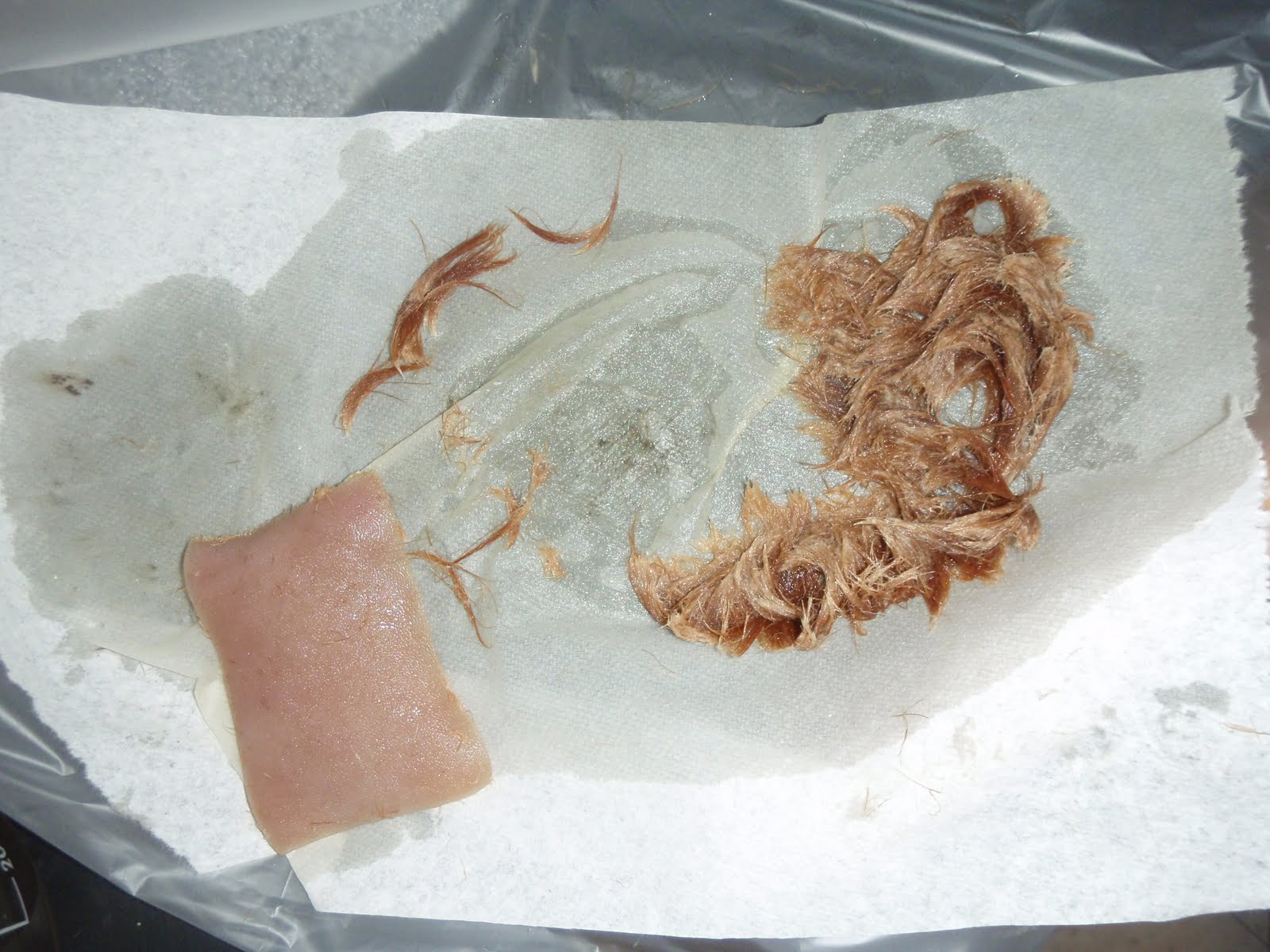
Soaking
Three large pieces of hide were cut for test strips and soaked in distilled water. They will be used for tanning with sumac leaves
Alum Tanning
No Change
Vegetable Tanning
No Change
I am a student in the University of Delaware's Summer Scholar's Research Program under the advisement of Dr. Cao of the Department of Fashion and Apparel Studies. Our project focuses on sustainable leather tanning methods. The majority of leather used in the modern apparel industry is tanned with the heavy metal chromium. Using environmentally friendly tanning methods, we hope to find a sustainable leather tanning process that provides leather with properties similar to chromium-tanned leather.
Showing posts with label Soaking. Show all posts
Saturday, July 16, 2011
July 11, 2011
Baiting
The large test strips were baited for the third time in the pepsin solution at 37 C. After several hours the fat had been removed from the pieces of hide and they were removed from the solution.
Soaking
The large test pieces were put in distilled water to remove the excess pepsin solution.
Debarking
Bark was removed from the oak branches using a draw knife to be used as a vegetable tannin. This bark was placed in distilled water to extract the tannins.
Alum Tanning
The piece of hide in the alum solution was left in solution to continue the tanning process.
The large test strips were baited for the third time in the pepsin solution at 37 C. After several hours the fat had been removed from the pieces of hide and they were removed from the solution.
Soaking
The large test pieces were put in distilled water to remove the excess pepsin solution.
Debarking
Bark was removed from the oak branches using a draw knife to be used as a vegetable tannin. This bark was placed in distilled water to extract the tannins.
Alum Tanning
The piece of hide in the alum solution was left in solution to continue the tanning process.
Monday, July 11, 2011
July 8, 2011
Dehairing
The two large test strips were removed from the lime solution and the hair was removed from them.
Soaking
The test strips were then added to distilled water to remove excess NaOH.
Baiting
The test strips were added to a solution of 2500 mL of distilled water, 25 g of pepsin, and 40 mL of acetic acid. This solution was heated to 37 C and stirred with the magnetic stirrer on the hot plate. This process continued for 3 hours.
Alum Tanning
The alum paste was left on the test strip.
The alum solution with the other test strip was stirred to recombine the separated layers of the solution.
The two large test strips were removed from the lime solution and the hair was removed from them.
Soaking
The test strips were then added to distilled water to remove excess NaOH.
Baiting
The test strips were added to a solution of 2500 mL of distilled water, 25 g of pepsin, and 40 mL of acetic acid. This solution was heated to 37 C and stirred with the magnetic stirrer on the hot plate. This process continued for 3 hours.
Alum Tanning
The alum paste was left on the test strip.
The alum solution with the other test strip was stirred to recombine the separated layers of the solution.
July 5, 2011
Alum Tanning
56 g of alum was dissolved in 950 mL of distilled water. The resulting solution had a pH of 4. In a separate beaker, 28 g of sodium chloride and 14g of sodium carbonate were dissolved in 340 mL of distilled water. The pH of this solution was 6. Both solutions were clear. The second solution was added to the first and both were stirred together. The solution began to foam and turned milky white.
200 mL of this solution was poured into a smaller beaker. Half of the third test strip was added to this solution to be alum solution tanned.
150 mL of the alum tanning solution was added to a beaker and unbleached wheat flour was added until the solution became a paste. This paste was applied to the other half of test strip 3.
Vegetable Tanning
The second test strip was removed from the vegetable tannin solution and soaked in distilled water to remove excess tannins from the hide.
Soaking
Two large pieces of goat hide were placed in distilled water to soak.
200 mL of this solution was poured into a smaller beaker. Half of the third test strip was added to this solution to be alum solution tanned.
150 mL of the alum tanning solution was added to a beaker and unbleached wheat flour was added until the solution became a paste. This paste was applied to the other half of test strip 3.
Vegetable Tanning
The second test strip was removed from the vegetable tannin solution and soaked in distilled water to remove excess tannins from the hide.
Soaking
Two large pieces of goat hide were placed in distilled water to soak.
Tuesday, June 21, 2011
June 20, 2011
Alum Tanning
The alum tanning process did not successfully tan the first test strip. The test strip remained cream colored and rubbery. It was unclear whether the alum tanning process did not work or if the test strip was not properly bated. The third test strip will be used to determine which process did not work.
Vegetable Tanning
The second test strip was left in the vegetable tanning solution. This piece has become deeper in color.
Dehairing
Hair was removed from the 3rd test strip.
Baiting
6 g of pepsin were added to 600 mL of distilled water and 18 mL of acetic acid. This solution was heated to 37°C. The third test strip was placed in this solution and the hot plate's magnetic stirrer was used to stirr the solution.
The alum tanning process did not successfully tan the first test strip. The test strip remained cream colored and rubbery. It was unclear whether the alum tanning process did not work or if the test strip was not properly bated. The third test strip will be used to determine which process did not work.
Vegetable Tanning
The second test strip was left in the vegetable tanning solution. This piece has become deeper in color.
Dehairing
Hair was removed from the 3rd test strip.
Soaking
The third test strip was soaked in distilled water to remove the sodium hydroxide.Baiting
6 g of pepsin were added to 600 mL of distilled water and 18 mL of acetic acid. This solution was heated to 37°C. The third test strip was placed in this solution and the hot plate's magnetic stirrer was used to stirr the solution.
June 16, 2011
Alum Tanning
Vegetable Tanning
300 mL of distilled water was combined with 100 mL of quercitannic acid solution obtained by soaking oak bark in distilled water. The second test strip was added to this solution. I plan to gradually increase the concentration of the solution to which this strip is exposed.
Trimming
A third test strip was cut from the large hide
Soaking
Monday, June 13, 2011
June 13, 2011
Pickling
90 mL of H2O, 30 g of unbleached flour, 30 g of NaCl, 30 g of KAl(SO4)2.12 H2O (Alum), and 15 mL of egg yolk (one egg yolk) were combined to form a paste.
This solution was applied to the test strip.
Dehairing
The second test strip was removed from liming solution and hair was removed in the same manner as was used for the first test strip.
Soaking
The second test strip was soaked in water to stop the liming process.
Vegetable Tannins
The oak bark pieces were removed from the solution in which they were soaking.
The first test strip was removed from the bating solution and placed in a solution of CH3COOH (acetic acid) and H2O with a pH of 4.5 to lower the pH of the hide in preparation for tanning. To create his solution 350 mL of H2O was mixed with 15 mL of CH3COOH. The hide remained in this solution for 2 hours.
Alum Tanning90 mL of H2O, 30 g of unbleached flour, 30 g of NaCl, 30 g of KAl(SO4)2.12 H2O (Alum), and 15 mL of egg yolk (one egg yolk) were combined to form a paste.
This solution was applied to the test strip.
Dehairing
The second test strip was removed from liming solution and hair was removed in the same manner as was used for the first test strip.
Soaking
The second test strip was soaked in water to stop the liming process.
Vegetable Tannins
The oak bark pieces were removed from the solution in which they were soaking.
June 10, 2011
Dehairing
The test strip was removed from the HaOH solution and laid flat on the table. NaOH solution was disposed of in a labeled hazardous waste container.
Hair was removed from the hide by running my fingers over the hair applying light pressure. Hair was discarded.
Soaking
The test piece was soaked in distilled water to remove the NaOH. The resulting solution had a pH of 7.5 and was discarded in the same hazardous waste container as the NaOH solution.
Baiting
1g of pepsin was added to 500 mL of H2O and heated to 37°C. Pepsin is an enzyme that digests proteins. In leather tanning, pepsin is used to dissolve unwanted proteins from the animal hide leaving behind tannable collagen in the skin.
Debarking
Bark was removed from oak branches with a draw knife for vegetable tanning.
The bark pieces were placed in distilled water to removed the quercitannic acid from them. Quercitannic acid is the tannin found in oak bark with the formula C76H52O46.
The solution immediately began to turn an amber color. The pH of this solution was 6.5.
The test strip was removed from the HaOH solution and laid flat on the table. NaOH solution was disposed of in a labeled hazardous waste container.
Hair was removed from the hide by running my fingers over the hair applying light pressure. Hair was discarded.
The test piece was soaked in distilled water to remove the NaOH. The resulting solution had a pH of 7.5 and was discarded in the same hazardous waste container as the NaOH solution.
Baiting
Debarking
Bark was removed from oak branches with a draw knife for vegetable tanning.
The bark pieces were placed in distilled water to removed the quercitannic acid from them. Quercitannic acid is the tannin found in oak bark with the formula C76H52O46.
The solution immediately began to turn an amber color. The pH of this solution was 6.5.
June 9, 2011
Trimming
A square approximately 9"x9" was trimmed from the large hide.
A square approximately 3"x3" was cut from the large hide for testing purposes.
Resalting
Excess wet salt was scraped from the hide.
550 g of NaCl was added to the large hide.
450 g of NaCl was added to the small hide.
Soaking
The 3"x3" test strip was placed in distilled water for 24 hours to remove blood and salt.
The solution had a pH of 7.5 when the piece of hide was removed.
Liming
An NaOH solution was made by combining 200 mL of H2O with 2 g of NaOH. The pH of this solution was 10. The 3"x3" test piece was placed in this solution at 1:45 pm.
Due to the high pH of the solution, the hide was checked for progress at 6:30 pm; however, the hair was still firmly attached to the hide at this time.
A square approximately 9"x9" was trimmed from the large hide.
A square approximately 3"x3" was cut from the large hide for testing purposes.
Resalting
Excess wet salt was scraped from the hide.
550 g of NaCl was added to the large hide.
450 g of NaCl was added to the small hide.
Soaking
The 3"x3" test strip was placed in distilled water for 24 hours to remove blood and salt.
The solution had a pH of 7.5 when the piece of hide was removed.
Liming
An NaOH solution was made by combining 200 mL of H2O with 2 g of NaOH. The pH of this solution was 10. The 3"x3" test piece was placed in this solution at 1:45 pm.
Due to the high pH of the solution, the hide was checked for progress at 6:30 pm; however, the hair was still firmly attached to the hide at this time.
Subscribe to:
Posts (Atom)